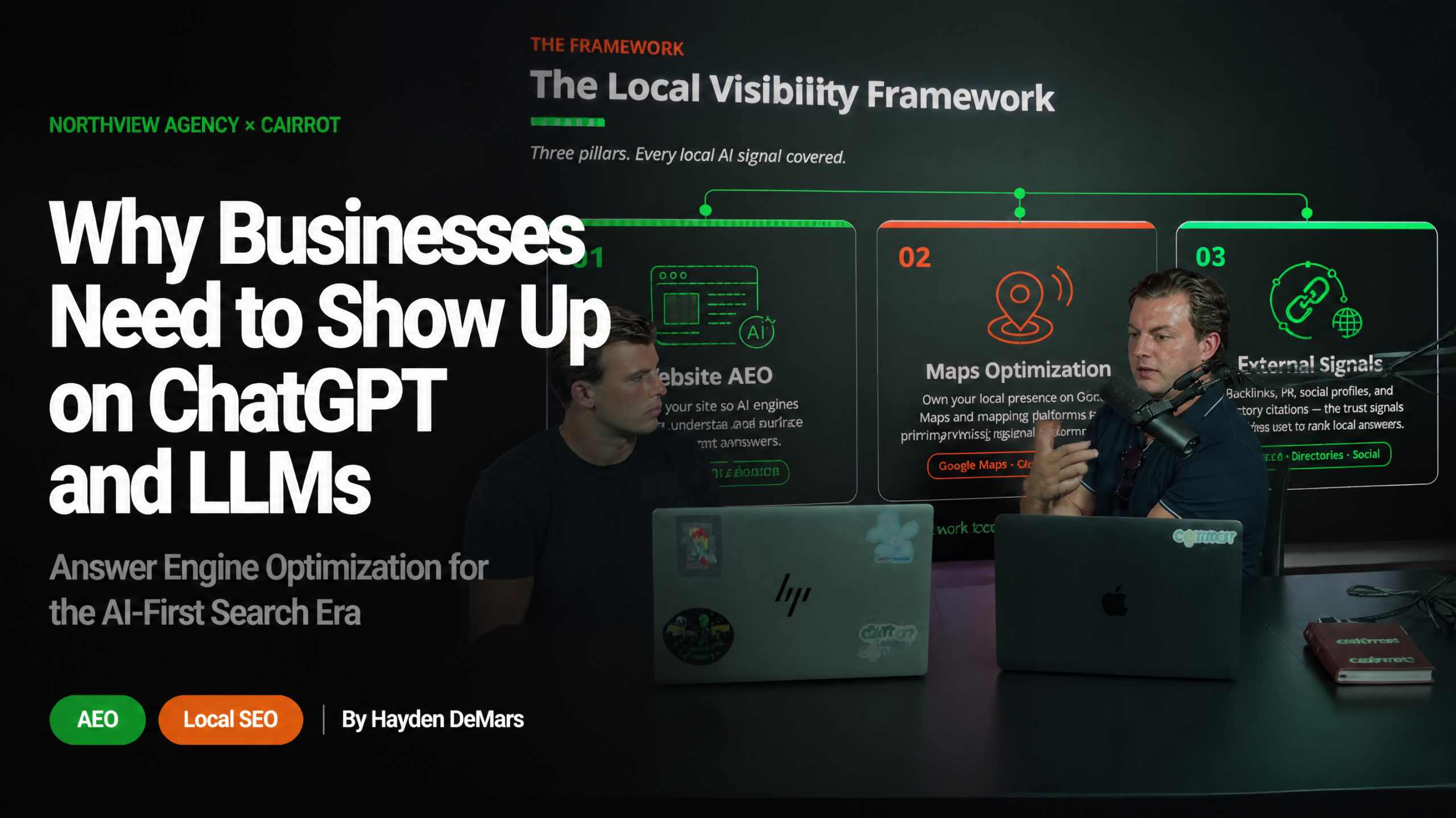
By Hayden DeMars, Founder of NorthView Agency and Connor Kimball, Co-Founder of Cairrot
Key Takeaways
- Customers are no longer just Googling. They’re asking ChatGPT, Gemini, Claude, and Perplexity who to hire, and AI gives them one or two answers instead of ten blue links.
- AEO (Answer Engine Optimization) is how you become that answer. It comes down to three pillars: your website, your maps listings, and your external signals.
- Most local businesses haven’t touched this yet, which means early movers get an outsized advantage right now. One of my clients started showing up in AI answers within his first 90 days, and it’s already producing patients.
- You can measure all of it: AI visibility tracking plus Search Console plus Analytics gives you a full proof loop, not a guessing game.
Search is changing faster than most businesses realize.
For years, local businesses have competed for visibility on Google. They have optimized websites, collected reviews, built service pages, and fought for map-pack rankings. But now, customers are not only searching on Google. They are asking ChatGPT, Perplexity, Gemini, Claude, and other AI tools for recommendations.
They are asking questions like:
• “Who is the best chiropractor near me?”
• “What company should I hire for local SEO?”
• “Where can I get acupuncture in Miami?”
• “Which business provides shockwave therapy in Tampa?”
• “What agency can help my business show up on ChatGPT?”
If your business is not being understood, trusted, and recommended by AI systems, you are already missing part of the next wave of search.
That is where AEO, Answer Engine Optimization, comes in.
AEO is the process of helping your business become visible inside AI-generated answers, not just traditional search results. And for local service businesses, the opportunity is massive. Most competitors are not thinking about this yet. They are still treating SEO like it is only about ranking on Google, while customers are beginning to ask AI tools who to trust.
At NorthView Agency, we help businesses adapt to this shift by improving the signals that search engines and AI tools use to understand, rank, and recommend companies. Through Cairrot, agencies can also track, manage, and improve their AI visibility with a more systematic AEO workflow.
The Big Shift: From Search Engines to Answer Engines
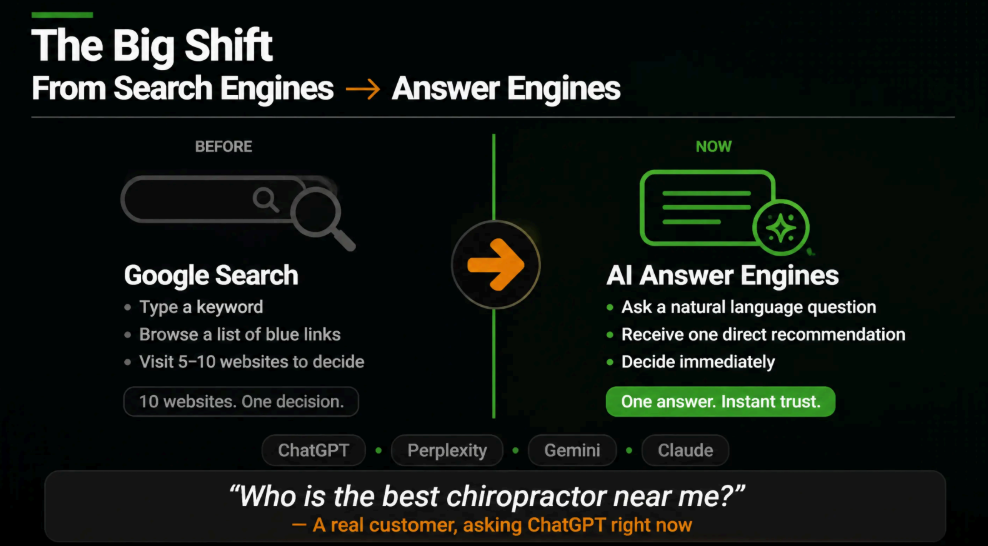
Traditional SEO is about showing up when someone types a keyword into Google.
AEO is about showing up when someone asks an AI assistant for an answer.
That difference matters.
A customer searching “Kitchen remodelers in Orlando” may still see a list of blue links or a map pack. But a customer asking ChatGPT, “Where should I go for a new kitchen designer near Orlando?” wants one, trustworthy, recommendation.
That means businesses need to give search engines and large language models enough confidence to understand:
• What the business does
• Where it operates
• Which services it offers
• Who provides those services
• Whether it is trusted by real customers
• Whether other sources across the web confirm the same information
Google and AI models are becoming more advanced, but they still rely on clear signals. As Connor explained in our conversation, Google is “smarter and smarter, but it’s still just a robot trying to figure out what we humans are talking about. You just have to give it confidence.”
That is the foundation of AEO.
Why Businesses Should Care About ChatGPT Visibility Now
Most local businesses are not ready for AI-driven discovery.
They may have a website. They may have a Google Business Profile. They may even have a few service pages and reviews. But the information is often incomplete, inconsistent, vague, or poorly structured.
That creates a visibility problem. AI-driven referral traffic to US retail sites surged 693% year over year during the 2025 holiday season. The buyers with money in hand are moving to AI faster than raw traffic numbers suggest.
If an AI engine cannot confidently understand what your business offers, where you offer it, and why you are credible, it is less likely to mention you in an answer. Predicted traditional search engine volume would drop 25% by 2026 due to AI chatbots and virtual agents. Which means less people are viewing you and going with your service.
Businesses need to start thinking about AEO because:
1. Customers are already using AI tools for recommendations.
People are asking ChatGPT and other LLMs for service providers, local options, product comparisons, and “best of” recommendations. Think about the actual moment your customer is in. Someone throws their back out on a Saturday.
Ten years ago they’d Google “chiropractor near me” and scroll through a map pack. Today, a growing share of them open ChatGPT and type “who’s the best chiropractor near me for lower back pain” and get one or two names. If you’re not one of those names, you were never in the conversation.
2. AI answers compress the decision journey.
Instead of browsing ten websites, a customer may trust a short AI-generated shortlist.
3. The businesses with the clearest signals are more likely to be surfaced.
AI systems need confidence. Clear website copy, accurate listings, consistent citations, reviews, backlinks, and service-specific content all help.
4. Early movers can win before the market gets crowded.
Many local businesses have not optimized for AI visibility yet. That gives proactive companies a real advantage.
5. AEO improvements also strengthen traditional SEO.
Better homepage structure, service pages, FAQs, maps optimization, citations, and backlinks help both search engines and answer engines.
The Three-Pillar AEO Framework
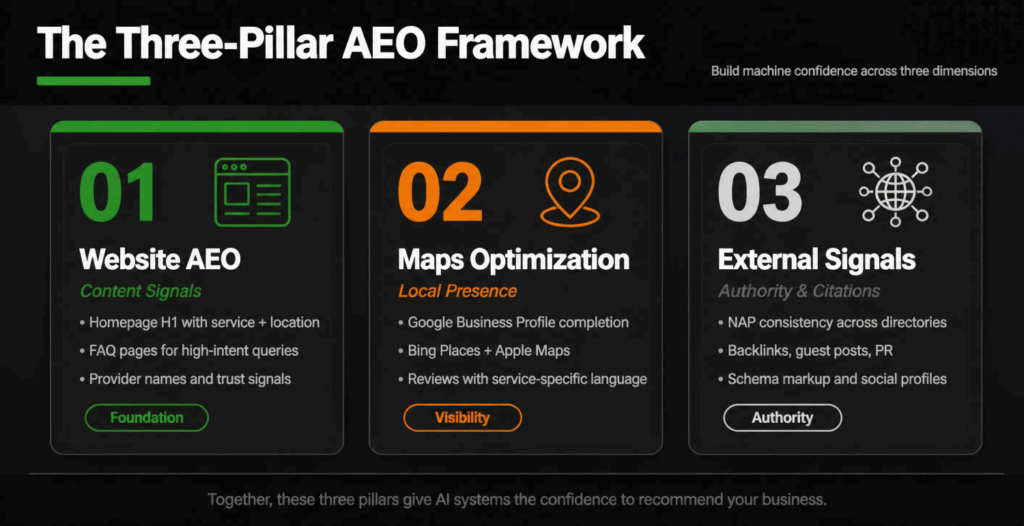
The strongest AEO strategy does not need to be complicated. For most local service businesses, results can be built around three pillars:
1. Website optimization
2. Maps optimization
3. External signals
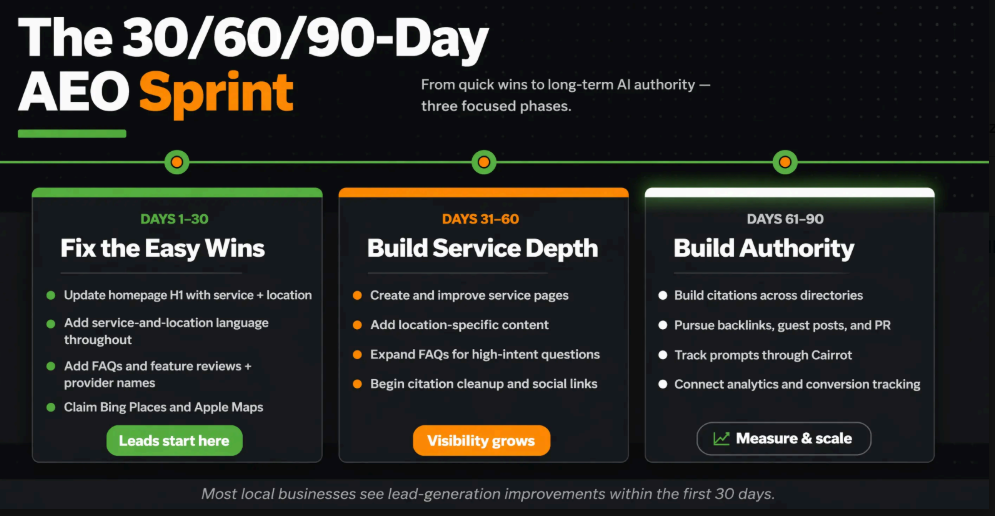
Connor’s core thesis is that nearly any local service business in any niche can get consistent AEO results by breaking optimization into these three areas. For many clients, this can be structured into a 30/60/90-day sprint, with lead-generation improvements often beginning in the first 30 days.
Let’s break down each pillar.
Pillar 1: Website Optimization
Your website is still the foundation of your online visibility.
For AEO and SEO, the homepage matters more than many businesses realize. In fact, many local businesses can make meaningful progress with focused homepage updates alone.
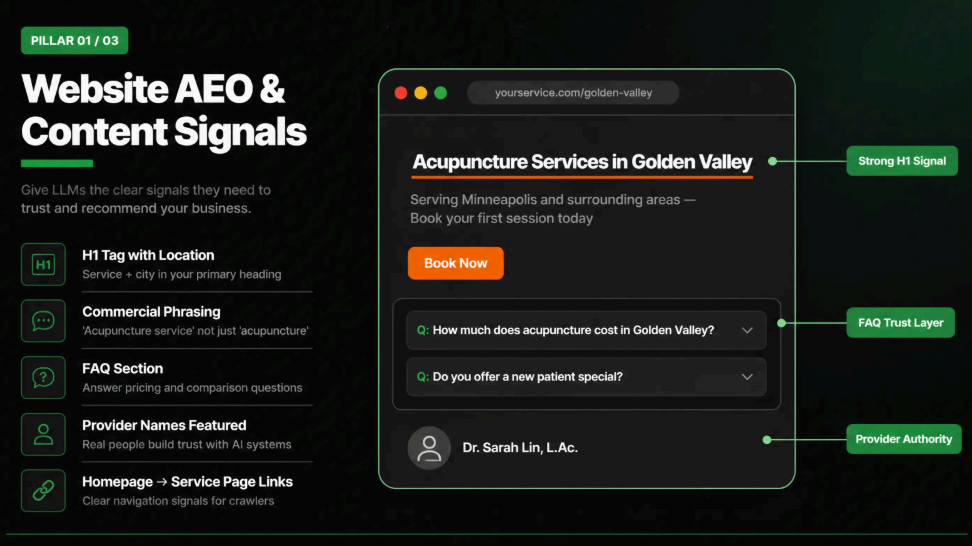
The biggest opportunity is often the H1 tag.
Your H1 is one of the clearest signals on the page. It tells Google, and by extension other systems that learn from the web, what the page is about. If your H1 is vague, you make it harder for search engines and AI models to understand your business.
For example, an acupuncture clinic with an H1 that simply says:
Acupuncture
is missing an opportunity.
That phrase does not clearly tell Google whether the page is a service page, a general guide, a review article, or a local provider.
A stronger H1 would be:
Acupuncture Services in Golden Valley
That tells search engines the service and the location.
This does not mean your homepage has to become ugly or robotic. Sales copy like “Move Forward, Look Forward” can still appear prominently on the page. But the true H1 should carry the keyword intent, and design or custom styling can make that work naturally.
Website Signals That Help AEO
Businesses should review and improve:
• Homepage H1: Include the primary service and location.
• Preheader or subheader: Add keyword-rich context, such as “Golden Valley Chiropractic, Acupuncture & Wellness.”
• Commercial phrasing: Use high-intent phrases like “acupuncture service,” “acupuncture care,” “special package,” or “service in [area].”
• Service framing: Write like a provider, not a generic guide. “Our acupuncture services relieve pain” is stronger than “acupuncture is great for pain relief.”
• FAQs: Add real customer questions, including pricing questions like “How much does acupuncture in Golden Valley cost?” Even if the answer is “call us,” the question itself helps match search intent.
• Homepage-to-service-page links: Link from the homepage to key service pages, even if they are already in the top navigation.
• Provider names: Feature the actual doctor, specialist, founder, or team member by name. Names can become search signals too.
• Reviews and videos: Add trust-building proof directly to the homepage.
These updates may sound simple, but they give search engines and AI tools more confidence about what your business does and who it serves.
This is exactly the type of work NorthView Agency helps businesses implement: turning unclear web pages into structured, high-intent assets that can perform better across Google, maps, and AI-driven search.
Pillar 2: Maps Optimization
For local service businesses, maps visibility is critical.
Most businesses already have a Google Business Profile, but many are missing other important map ecosystems. Two of the biggest overlooked opportunities are:
• Bing Places
• Apple Maps
Setting these up can be a major early win, especially for businesses that have never claimed or optimized them.
Apple Maps can matter even more in the United States, particularly for mobile-first industries like restaurants, retail, and walkable local services. Google still dominates in many markets globally, but businesses should not ignore the platforms their customers use every day.
Maps Signals That Help AEO
Businesses should optimize:
• Business title: Your business name is often one of your strongest keywords. For multi-location businesses, adding the location can help clarify relevance, such as “Coastal Chiropractic St. Pete.”
• Service fields: Fill out every relevant service category and service description.
• Attributes: Add details like parking, bathrooms, accessibility, and other customer-facing features.
• Reviews: Encourage reviews and respond to them.
• Review replies: Use service-specific language naturally. For example: “We’re so glad our acupuncture treatments helped you heal.”
Most businesses do not respond to reviews consistently. That creates an opening. Review replies are not just customer service; they are also another place to reinforce what your business does.
Pillar 3: External Signals
Your website and maps profiles are not the only places AI systems look for confidence.
External signals matter too.
These include citations, backlinks, social profiles, PR mentions, guest posts, and other third-party references that confirm your business is real, relevant, and trusted.
A strong external-signal strategy includes:
• NAP consistency: Make sure your name, address, and place information is accurate across directories.
• Local citations: Build or clean up listings across major business directories.
• Social links: Ensure existing profiles such as Facebook, YouTube, and X link back to your website.
• Schema markup: Use schema to connect your website with social profiles and other business entities.
• Backlinks: Earn links through guest posts, link inserts, partnerships, PR, and relevant local or industry publications.
• PR: Announce new services, locations, or milestones in a way that creates external authority.
The right mix depends on the business.
A newer business with a weaker website may need more external authority. An established company with authority but weak content may need better service pages and on-page structure. The strategy should match the business’s current position.
This is where NorthView Agency can help businesses prioritize the work that matters most instead of randomly chasing tactics.
The AEO Tools I’m Actually Using to Get Results for Clients
I get asked this constantly: what software do you actually run this stuff on?
Here’s the honest answer. I’ve tested a lot of tools in this space, and most of them are either repackaged SEO dashboards with “AI” slapped on the label, or they track vanity metrics that don’t tell you whether a real customer found you through an AI answer.
The stack I run for my clients right now looks like this:
For citations and local listings, I use a platform that lets me push consistent NAP data (name, address, place) across a wide directory network in bulk instead of building listings one at a time. Consistency across directories is one of the strongest confidence signals you can give an AI model, and doing it manually is a nightmare.
For AI visibility tracking, I use Cairrot. Full transparency: I work closely with the Cairrot team, so take that however you want. But the reason I use it is simple. It’s built around the actual workflow instead of a vague checklist. It tells clients which website updates to make, lets them manage their Google Maps listing, and tracks the specific prompts that matter to their business, like “best chiropractor near me” or “shockwave therapy in Tampa.” Apple Maps support and bulk citation pushing (around 100 NAP citations in one upload) are on the roadmap, and social profile management is coming after that.
For everything else, it’s not software. It’s reps. Rewriting H1s, building service pages, responding to reviews with service-specific language, and earning real backlinks. No tool does that part for you.
I’ll do a full breakdown post soon ranking every AEO tool I’ve tested, which ones are worth it and which ones aren’t. If you want that when it drops, keep an eye on the blog.
How I Prove AEO Is Working as an Agency Owner in Florida
The number one question I get from business owners is the right one to ask:
How do I know this is actually working?
I run my agency out of Tampa, and I refuse to sell anything I can’t measure. AEO is not a mystery, and anyone treating it like one is hiding something. Here’s the exact proof loop I run for every client:
- AI visibility tracking. I track the specific prompts tied to each client’s priority services. For a chiropractor, that might be prompts around “shockwave therapy” or “pregnancy chiropractic care.” I want to know, week over week, whether AI tools are mentioning them when it counts.
- Google Search Console comparison. I compare how often the site showed up for those keywords three months ago versus today. Impressions, clicks, and average position over time. This is the leading indicator that the groundwork is taking hold.
- Google Analytics conversion tracking. Visibility that doesn’t turn into phone calls is decoration. I connect the visibility gains to actual leads, conversions, and revenue.
Here’s what that looks like in real life. One of my clients, a functional medicine doctor in Colorado, was about 70 days into working with me when a new patient walked in and told him she found him by asking Claude about functional medicine doctors in her area. He showed up in the answer. That’s not a ranking report. That’s a patient in the door.
AI visibility + Search Console movement + conversion data = AEO you can actually prove.
That’s the standard I hold my own work to, and it’s the standard you should hold any agency to.
How I Built Northview for This Exact Moment
The businesses that win the next era of search will be the ones that make themselves easy for AI to understand and easy for customers to trust.
That requires more than keyword stuffing.
It requires:
• Clear service positioning
• Strong local relevance
• Better website structure
• Complete maps profiles
• Consistent citations
• Trust signals
• Backlinks and PR
• Prompt tracking
• Conversion measurement
NorthView Agency helps businesses put those pieces together. The goal is not just to “rank higher.” The goal is to help your business become the obvious answer when customers search, ask, compare, and decide.
And with Cairrot, the AEO process becomes more trackable, repeatable, and actionable.
Quick AEO FAQ
What is AEO (Answer Engine Optimization)?
AEO, or Answer Engine Optimization, is the practice of getting your business surfaced when someone asks an AI assistant like ChatGPT for an answer or recommendation. While traditional SEO focuses on ranking when someone types a keyword into Google, AEO focuses on being the trusted answer AI tools give directly.
How is AEO different from traditional SEO?
SEO is about showing up when someone types a keyword into a search engine, while AEO is about showing up when someone asks an AI assistant for an answer. The good news is they reinforce each other: better homepage structure, service pages, FAQs, maps listings, citations, and backlinks help both search engines and answer engines.
Why do businesses need to show up on ChatGPT and other LLMs?
Customers already use AI tools to find service providers, compare options, and get u0022best ofu0022 recommendations, and AI answers compress the decision journey from ten websites down to one short shortlist. Businesses with the clearest signals are more likely to be surfaced, and because many local businesses have not optimized for AI visibility yet, early movers gain a real advantage.
How do AI tools decide which businesses to recommend?
AI tools look for confidence signals: clear website copy, accurate listings, consistent citations, reviews, and backlinks that confirm a business is real, relevant, and trusted. As the article puts it, Google is still a robot trying to figure out what humans are talking about, so your job is to give it confidence.
What is the three-pillar AEO framework?
The framework breaks AEO into three areas: website optimization (clear, service- and location-specific on-page content), maps optimization (Google Business Profile plus Bing Places and Apple Maps), and external signals (citations, backlinks, social profiles, and PR). Focusing on these three pillars lets almost any local service business build consistent AEO results.
How can I optimize my website for AEO?
Start with your homepage: use an H1 that includes your primary service and location, add a keyword-rich subheader, use high-intent commercial phrasing, link from the homepage to key service pages, feature your providers by name, and add reviews and video as trust signals. For many local businesses, focused homepage updates alone can create meaningful progress.
Which map platforms should local businesses claim beyond Google?
Beyond a Google Business Profile, businesses should claim Bing Places and Apple Maps. Apple Maps matters especially in the U.S. for mobile-first industries like restaurants, retail, and walkable local services, and claiming these overlooked platforms can be a major early win.
What are external signals in AEO and why do they matter?
External signals are third-party references such as citations, backlinks, social profiles, PR mentions, and guest posts that confirm your business is real, relevant, and trusted. A strong strategy includes NAP (name, address, place) consistency across directories, local citations, backlinks from industry publications, and PR that announces new services or milestones.
How do you measure AEO results?
Results are measured with a three-part proof loop: AI visibility tracking of the specific prompts tied to your priority services, Google Search Console comparisons of impressions, clicks, and ranking positions over time, and Google Analytics conversion tracking that connects visibility gains to leads and revenue.
How long does it take to see AEO results?
AEO work is often structured as a 30/60/90-day sprint: fixing easy wins in the first 30 days, building service depth from days 31 to 60, and establishing AI authority from days 61 to 90. Lead-generation improvements often begin within the first 30 days.
Final Takeaway
You don’t need to panic about AI search. You need to move.
I’ve watched this shift happen inside my own client accounts. The businesses with clear websites, complete maps listings, consistent citations, and real trust signals are the ones AI recommends. The ones with vague homepages and thin service pages are invisible, and they don’t even know it yet.
The gap between those two groups is going to get wider every month. Gartner projected traditional search volume would drop 25% by 2026 because of AI assistants, and the customers making buying decisions are moving to AI even faster than the traffic numbers show.
If you want your business to be the answer when customers ask ChatGPT who to hire, I can build that foundation with you at Northview Agency. We’ll map your current visibility, fix the highest-leverage gaps first, and track the whole thing so you can see it working.