By Hayden DeMars, Founder of Northview Agency, and Connor Kimball, Co-founder & CEO of Cairrot
Key Takeaways
Like most business owners, Law Firms are not thinking about how they are showing up on ChatGPT, Claude, Gemini etc.
They are losing cases because search engines, AI platforms, and real potential clients do not have enough clear information to understand what the firm handles, where it handles it, and why it should be trusted.
The same issues show up over and over again:
- One generic “Practice Areas” page instead of dedicated pages per case type
- Weak keywords in titles, H1s, H2s, and image alt text
- Attorneys who are invisible as individuals, not just as a firm
- Missing or half-finished profiles on the legal directories AI platforms actually pull from
- Google Business Profiles that are underbuilt and underused
- No schema markup telling search engines this is a law firm at all
These simple issues are usually the exact reason a firm is invisible in Google, ChatGPT, Perplexity, Gemini, Claude, and Google’s AI Overviews.
Here’s how I do it. First, I establish the baseline. I want to know how many calls and consultations are coming in, where they are coming from, which practice areas are already getting found, and which ones are basically invisible.
Then I use Cairrot to track the AEO side of the equation. Visibility by practice area and region. Organic traffic from both search and AI. Crawl activity. AI platform visibility. The stuff that tells me whether a firm is actually being understood by the systems that now influence how people choose lawyers.
The demand shift is already here. 28.1% of consumers said they would use ChatGPT to research a lawyer in 2025, up from 20.5% in 2024 and just 9% in 2023. And 74% of legal clients still research a firm online even after getting a personal referral.
So what does that mean?
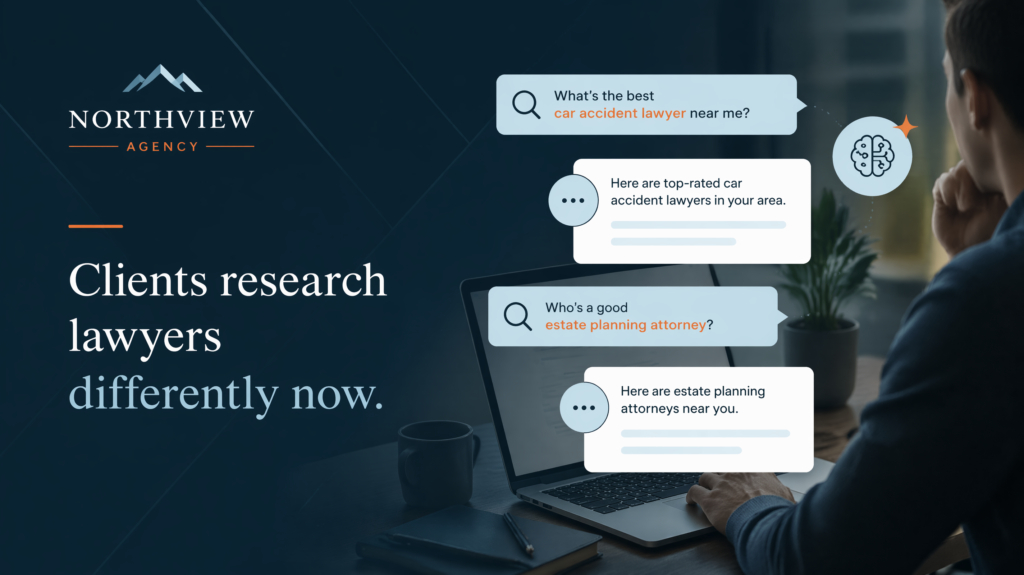
It means when someone in your city asks ChatGPT, “Who is the best car accident lawyer in Tampa?” or “What estate planning attorney near me handles special needs trusts?” your firm either shows up or it doesn’t. It also means your best referral can quietly die if the AI tools that person checks afterward recommend your competitor instead.
This guide walks through exactly how I take law firms from invisible to findable, rankable, and citable using the same process I use with clients at Northview Agency.
The Most Common AEO Issues I Find on Law Firm Websites
Before I ever talk tactics with a new firm, I can usually predict what I am going to find. It is almost always some version of the same problems. The attorneys might be excellent. The case results might be genuinely impressive. But the website does not explain any of it clearly enough for search engines, AI platforms, or potential clients.
1. One “Practice Areas” page instead of dedicated case-type pages
Most firms have one page that lists everything they handle in a few bullet points.
It usually looks something like this:
- Personal injury
- Family law
- Criminal defense
- Estate planning
- Business litigation
- Employment law
That might be fine for a quick menu, but it is not enough for getting recommended by ChatGPT. Search engines and AI platforms recommend pages, not vague lists. If you handle car accidents, truck accidents, and slip-and-fall cases, but all three live under one generic “Personal Injury” page, you are not giving Google or AI search engines enough to work with.
You are basically saying, “Here is everything we do. Good luck figuring it out.” Which, as a strategy, is not great.
And in legal, I take this one level deeper than I do in any other niche. Every practice area needs its own page, and every meaningful case type within that practice area needs its own page too. Not just “Personal Injury” but car accidents, truck accidents, motorcycle accidents, slip-and-fall, and wrongful death. Not just “Family Law” but divorce, child custody, child support, and prenuptial agreements.
Why so granular? Because law is the most competitive niche there is. You are not going to out-rank the firms spending seven figures a year on the broad terms. But “truck accident lawyer” in your city, with a genuinely useful page behind it, is a fight you can actually win. Niche down early. Specificity is the whole game.
A strong case-type page usually answers:
- What is this case type?
- Who is it for?
- What situations, injuries, or disputes does it relate to?
- What happens during the free consultation?
- Why is this firm qualified to handle it?
- Where does the firm handle these cases?
- What should someone do next?
2. Weak or irrelevant words in the places that matter most
Your title tag, H1, H2s, and image alt text are some of the highest-leverage spots on your website, and most law firm websites waste them. I constantly see homepages with an H1 like “Fighting For You Since 1994,” which tells me nothing. More importantly, it tells Google, ChatGPT, and Perplexity nothing.
If you are a personal injury firm in Tampa, your H1 should say something closer to “Tampa Personal Injury Lawyers,” not “Justice Starts Here.” That line might sound nice on a billboard, but it does not help search engines understand what you do. The words you use in key places define the page, giving search engines and AI systems context about your practice areas, your location, and your relevance.
SEO/AEO important titles
The biggest places I check first are:
- Title tags
- H1s
- H2s
- Meta descriptions
- Image alt text
- Navigation labels
- Internal link anchor text
- Practice area page headings
If Google can’t understand it, why would ChatGPT or Gemini?
3. Attorneys who are invisible as people
This one is bigger in legal than in almost any other niche. People do not hire law firms. They hire lawyers.
When someone asks ChatGPT, “Who is the best DUI attorney in Orlando?” the answer is going to name individual attorneys, not just firm brands. If your lawyers only exist as a name and a headshot on a shared “Our Team” page, AI platforms have almost nothing to work with.
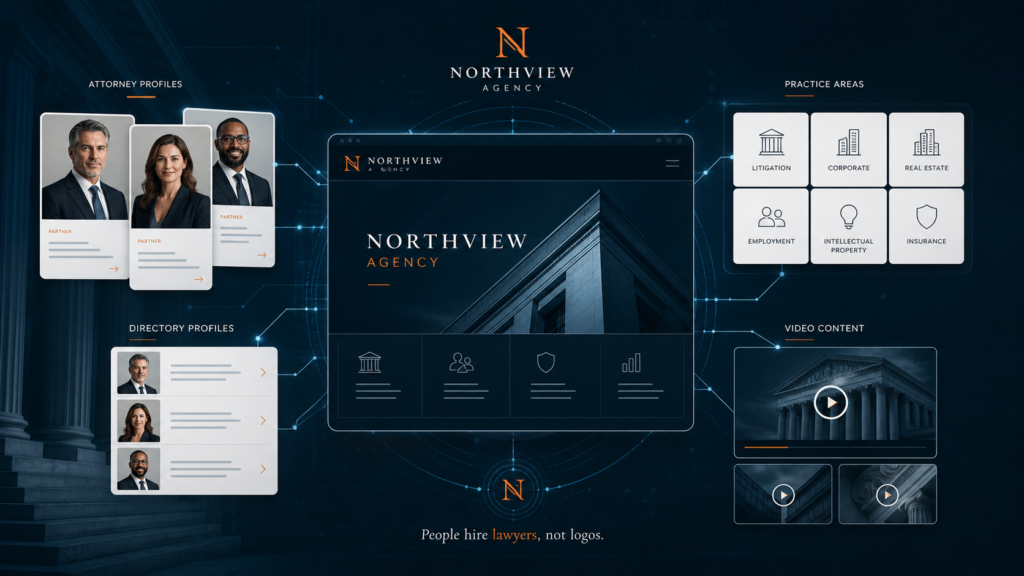
Each attorney should be treated like a sub-business of the firm:
- A dedicated bio page with their practice focus, bar admissions, education, notable results, and publications
- Person schema markup on that page
- Their own profiles on the legal directories (more on those in a second)
- Their face and voice in the firm’s video content
By the way, this is not just a law thing. It applies to any business built around a founder or a leader. Connor is doing this right now with his own name at Cairrot, building the personal entity alongside the company entity, because AI platforms understand people and businesses as connected entities that reinforce each other. Law just happens to be the niche where ignoring it costs you the most.
4. Missing or abandoned legal directory profiles
Legal has something most niches do not: an entire ecosystem of established, high-authority directories that search engines and AI platforms already trust. When ChatGPT gets asked about lawyers in a city, these directories are frequently where the citations come from.
Go make profiles on these. Complete ones. For the firm and for each attorney:
- Avvo
- FindLaw
- Justia
- Martindale-Hubbell
- Super Lawyers
- Lawyers.com
- NOLO
- Your state bar association’s directory
I see firms with an empty Avvo profile ranking below solo attorneys who filled theirs out completely. The directories matter for three reasons: they rank in Google for lawyer searches themselves, they feed AI platforms trusted third-party validation, and they create consistent entity signals that connect your attorneys, your firm, your practice areas, and your location.
5. An unoptimized Maps profile with no dedicated content
Your Google Business Profile is often one of the biggest drivers of local calls, and most firms treat it like a digital business card they set up once and forgot about.
How not to do SEO/AEO
The common issues are usually obvious:
- No practice areas listed as services
- No fresh photos
- No regular posts
- Unanswered reviews
- Weak or incorrect categories (“Lawyer” instead of “Personal injury attorney”)
- No clear link between the website and the Google Business Profile
- No dedicated website content supporting the case types they want to rank for
Then they wonder why a competitor is showing up above them in Maps. AI search still needs trusted local data to understand which firms are relevant, credible, and worth recommending. If your Google Business Profile is weak, you are making that harder than it needs to be.
6. No legal schema markup
Schema markup is structured data you add to your website that explicitly tells search engines and AI platforms what your business is. Most law firm websites have none, which means the machines reading your site are left guessing.
At minimum, a law firm should have:
- LegalService schema on the homepage and practice area pages, defining the firm, its location, its service areas, and the types of law it practices
- Attorney schema (or Person schema with legal properties) on each individual attorney bio page, covering their name, role, bar admissions, education, and areas of practice
- FAQPage schema on pages that answer common client questions
This is not glamorous work. Nobody sees it. But it is one of the clearest, most machine-readable signals you can send about who you are, what you do, and where you do it. In a niche where AI platforms are deciding which attorneys to name, being explicit beats being implied.
How I Start With Every Client
The first thing I want to know is simple: how many calls and consultations are coming in right now, where are they coming from, and which practice areas are actually getting found? Most firms do not have a clean answer.
They might know they got a few calls from Google. They might know a case came in through Avvo. They might have some GA4 data, some Google Search Console data, an intake spreadsheet, and a general feeling that “marketing is working” or “marketing is not working.”
So when I start with a firm, I use Cairrot to get the AEO baseline and understand where the practice stands across AI search, traditional search, and crawl activity. This is one of the reasons I use it so heavily.
The AEO KPIs I Track in Cairrot
Once the baseline is set, I track three core AEO KPIs inside Cairrot:
- Visibility by practice area and region
- Organic traffic from both search and AI
- Crawl activity on the website
These are the numbers that help me understand whether the firm is becoming easier for search engines and AI platforms to find, understand, and recommend.
1. Visibility by practice area and region
I don’t just want to know if the website “ranks.” That is too vague. I want to know whether the firm shows up when someone asks ChatGPT, Gemini, Perplexity, Claude, or Google about a specific case type in a specific area.
For example, if a personal injury firm handles car accidents, truck accidents, slip-and-fall, and wrongful death, I want to know how visible they are for each of those case types in the market they actually serve.
Same thing for a family law practice. If they handle divorce, custody, support modifications, and prenups, I want to know which of those services AI platforms understand and which ones are basically invisible.
That is where Cairrot is useful. It helps me see the visibility gaps by case type and region, not just overall traffic. And in legal, those gaps are usually dramatic. A firm might have decent visibility for its broad practice area and be completely absent for the specific case types that actually drive their best cases.
2. Organic traffic from both search and AI
Traditional Google traffic still matters. A lot. I don’t buy the “SEO is dead” thing. Usually, when someone says SEO is dead, they are either selling something or they stopped doing SEO well.
But AI traffic matters too. So I use Cairrot to help separate what is happening in traditional search from what is starting to happen across AI platforms. I want to know whether the firm is only getting found in Google, or whether it is also starting to appear in AI-driven discovery paths.
That distinction matters, because if ChatGPT, Perplexity, Gemini, Claude, or Google’s AI Overviews are starting to mention a firm, that is a completely different kind of visibility than a normal blue-link ranking. It is also arriving at a different point in the decision. Someone who asks an AI tool “do I need a lawyer for this?” and gets your firm named in the answer is further along than someone scanning ten blue links.
3. Crawl activity
Crawl activity is one of the most overlooked metrics. How often are search engine and AI bots actually visiting and reading the site?
You can have the most impressive case results page in the world, but if it is not discoverable, crawlable, and connected to the rest of the site, it is just sitting there looking impressive. Which is nice. But impressive does not sign retainers.
This is where Cairrot helps me understand whether the site is actually being seen by the systems we care about. If crawl activity is weak, that tells me we may need to fix technical access, internal linking, content structure, sitemap issues, or the way important pages are connected. Basically, Cairrot helps me answer the question I care about most at the start of every engagement:
What is stopping this firm from being found? Once I know that, I can prioritize the work.
Sometimes the answer is homepage optimization. Sometimes it is missing case-type pages. Sometimes it is empty directory profiles. Sometimes it is schema. Sometimes it is Google Business Profile. Usually, it is a combination.
I want the baseline, the gaps, and the order of operations.
Here is a full breakdown on why these metrics matter: The AEO Metrics and SEO KPIs That Actually Measure AI Visibility.
An Honest Word About Competitiveness
Here is the section most agencies will not write.
Law is the hardest niche to do this in. Personal injury, criminal defense, and family law are brutally competitive in nearly every metro market. Established firms have fifteen-year-old domains, thousands of backlinks, hundreds of reviews, and paid budgets that would make your accountant sweat.
What that means practically:
The timeline runs longer. In wellness, I regularly see meaningful movement by month 3. In legal, foundation work still lands in months 1 through 3, but the real inflection in competitive markets is more often months 4 through 6, and competitive metro terms can take longer than that. Anyone promising you page one for “car accident lawyer” in a major city in 90 days is lying to you.
Newer firms need accelerants. If your firm is young, your domain is new, or your review count is thin, organic AEO/SEO alone will be slow. I tell those firms directly: plan on digital PR (earning coverage and citations in legal publications, local news, and industry press to build the authority signals AI platforms trust) and some paid advertising (Google LSAs and search ads on your highest-value case types) to keep cases coming in while the organic foundation matures. Paid is the bridge. Organic is the asset. You run both until the asset can carry the weight.
Specificity is your way in. You will not beat the giants on the broad terms. You can absolutely beat them on “motorcycle accident lawyer” in your county, or on the specific questions AI platforms get asked every day that the big firms’ template content answers badly. Niche down early, own the specific, and expand from strength.
None of this changes the process. It changes the expectations. And I would rather set them honestly now than explain them awkwardly at month 4.
What Results Actually Look Like: 1, 3, and 6 Months
I set expectations honestly with every client. So I’ll do the same here. AEO and SEO are not magic. You do not publish one case-type page and wake up the next morning with ChatGPT sending you 30 signed cases.
What usually happens is more gradual. The site becomes easier to crawl. The case-type pages become clearer. The directory profiles fill in. The Google Business Profile gets stronger. AI platforms start getting better context. Rankings move. Visibility improves. Calls start increasing. Then it compounds.
Month 1: Foundation
In the first month, the work usually includes:
- Setting up baseline tracking in Cairrot
- Reviewing current calls, consultations, and traffic sources
- Identifying the weakest practice area and region visibility gaps
- Cleaning up homepage messaging and metadata
- Starting or updating the most important practice area and case-type pages
- Building or completing directory profiles for the firm and each attorney
- Adding LegalService, Attorney, and FAQPage schema
- Improving internal links
- Building out the Google Business Profile
- Watching crawl activity start to move
Calls may not change much yet, and that is normal. The work is making the firm easier for search engines and AI platforms to understand. That is the first step. You have to become understandable before you become recommendable.
Month 3: Early movement
In wellness, month 3 is usually the inflection point. In legal, it is where I expect to see the early signals: visibility climbing for specific case types, crawl activity up, directory profiles getting found, Maps rankings improving for the more specific terms, and the first calls that clearly trace back to organic or AI-driven discovery.
I have seen this process produce inflection points in other niches that I would not have believed secondhand. One functional medicine client went from about 3 discovery calls per month to 13 in his best week within 90 days, including a patient who found him through Claude. A rural chiropractor started pulling patients from a metro area four hours away after we built out pages for his most differentiated program. The process transfers. Legal just adds more competition on top of it, so the curve stretches.
Month 6: The inflection point
By month 6, the offering pages have aged. Reviews have stacked up. The directory profiles have history. The blog library is deeper. The Google Business Profile has consistent activity. The attorneys exist as entities. AI platforms have more content to pull from.
By this point, the strongest firms usually have:
- More visibility across specific case types
- Stronger local rankings, especially on the niche terms
- More qualified organic traffic
- Better AI search presence
- More calls from potential clients who already understand what the firm handles
- Less dependence on paid ads for every case
In the most competitive metros, the compounding continues well past month 6. That is not a bug. That is what building an asset instead of renting attention looks like.
Frequently Asked Questions
What’s the difference between AEO and SEO?
SEO is about optimizing your website to rank in traditional search results like Google. AEO, or Answer Engine Optimization, is about optimizing your firm to be cited, recommended, and understood by AI platforms like ChatGPT, Claude, Gemini, Perplexity, and Google’s AI Overviews.
How long before I see new cases from this?
Foundation work in months 1 through 3, early movement by month 3, and the real inflection point around month 6 for most firms. Legal takes longer than other niches because it is the most competitive one. Anyone promising faster in a major metro is selling you something.
Do I still need to run ads?
If your firm is established with strong reviews and an aged domain, maybe not for long. If your firm is newer, yes, plan on paid advertising and digital PR as a bridge while the organic foundation matures. The goal is to build the asset that reduces your dependence on paid over time, not to pretend the bridge isn’t needed.
Which legal directories actually matter?
Start with Avvo, FindLaw, Justia, Martindale-Hubbell, Super Lawyers, Lawyers.com, NOLO, and your state bar directory. Complete profiles for the firm and every attorney. These directories are trusted third-party sources that AI platforms cite when recommending lawyers.
Should every attorney have their own bio page?
Yes. People hire lawyers, not logos. Each attorney needs a dedicated bio page with Person schema, their own directory profiles, and their face in the firm’s video content. AI platforms recommend individual attorneys by name, and they cannot recommend an entity they cannot see.
Does this work for solo attorneys and small firms?
Yes, and in some ways it works better. Specificity beats size. A solo attorney who owns “prenuptial agreement lawyer” in their county with a genuinely useful page, complete directory profiles, and consistent video content can out-rank a 40-lawyer firm’s template page for that term.
What is Cairrot, and do I need it?
Cairrot is the AEO tracking platform I use to measure visibility, AI traffic, crawl activity, and where a business is showing up across AI search experiences. Through Cairrot, I can track how a firm shows up across ChatGPT, Gemini, Perplexity, Claude, Google AI Overviews, and other AI search experiences. That gives me a clearer picture than traditional SEO tools alone.
Learn More About AEO for Law Firms
If you run a law firm and you want to know where you actually stand, this is where I start. I’ll review your site, pull your baseline visibility, look at your practice area pages, check your directory profiles and Google Business Profile, see how visible your attorneys are as individuals, and tell you honestly what your first three tactics should be, including whether your market means you need paid advertising in the mix.